
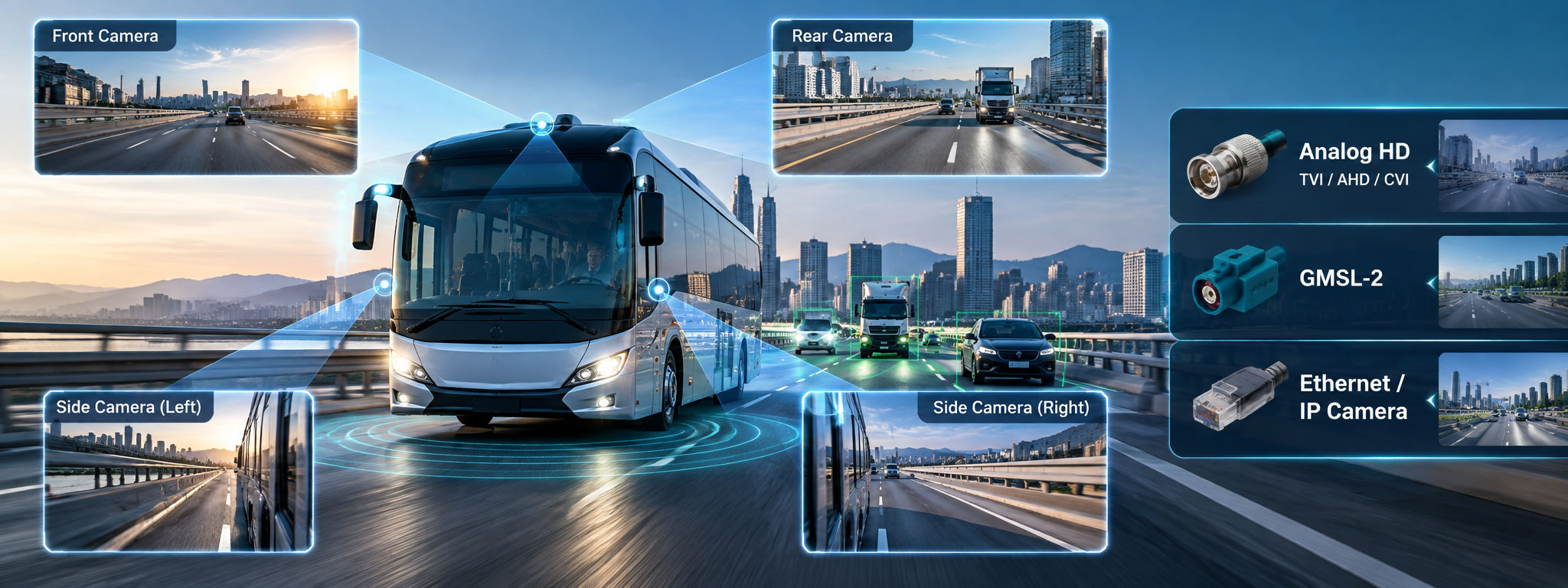
How to Choose Camera Interfaces for In-Vehicle Edge AI
Key considerations for analog HD, GMSL-2, and Ethernet cameras in multi-camera vehicle systems.
Camera interface selection is an important part of designing an in-vehicle edge AI system. The right choice depends not only on image quality, but also on camera count, cabling, transmission distance, latency, installation requirements, and the computing platform used to process video data.
For system integrators, understanding the differences between common camera interfaces can help simplify system design and ensure that the selected architecture fits the intended vehicle application.
1. Start with the Camera and Application Requirements
Before selecting an interface, define how the camera system will be used.
A multi-camera system for driver assistance, surround-view monitoring, passenger safety, fleet operations, or mobile video analytics may have very different requirements. Consider the number of cameras, required resolution and frame rate, cable routing, installation distance, environmental conditions, and whether AI inference will run locally on the vehicle computer.
It is also important to evaluate the complete video path—from camera input and video acquisition to processing, storage, and communication with other vehicle systems.
2. Analog HD for Existing and Multi-Camera Video Systems
Analog HD technologies such as TVI, AHD, and CVI can be useful when a deployment needs to work with compatible analog HD cameras or existing video infrastructure.
One advantage is the ability to transmit HD video over coaxial cabling, which may be practical for certain vehicle installations and system upgrades. For applications using multiple cameras, the computing platform must provide the appropriate video inputs and support the required camera configuration.
Rather than selecting an interface based only on resolution, system designers should also consider existing camera infrastructure, cable requirements, installation complexity, and how video will be captured for local processing.
For example, a multi-camera computing platform such as the IBOX-601-TVI8 can be considered when a vehicle application requires integration with multiple compatible analog HD camera inputs and edge computing in the same system.
3. GMSL-2 for High-Speed Camera Connectivity
GMSL-2 is another option for embedded and vehicle camera architectures where high-speed video transmission and robust camera connectivity are important.
It is commonly considered for systems that integrate cameras closely with an embedded computing platform. Depending on the camera and system design, GMSL-2 can support high-bandwidth video transmission while reducing the complexity associated with separate data and control connections.
However, compatibility should always be evaluated at the system level. Camera modules, connectors, serializers/deserializers, supported resolutions, and the computing platform all need to work together.
For this reason, GMSL-2 should not be selected simply because it offers high-speed connectivity. The complete camera ecosystem and deployment requirements should be validated first.
4. Ethernet and IP Cameras for Network-Based Video
Ethernet cameras are well suited to applications where cameras need to operate as network devices.
IP-based architectures can provide flexibility in camera placement and system expansion, particularly when video needs to be shared across multiple systems or integrated into an existing Ethernet network. Power over Ethernet can further simplify installation when supported by both the camera and computing platform.
At the same time, network architecture becomes an important consideration. Bandwidth requirements increase as camera count, resolution, and frame rate increase. Designers should evaluate available network bandwidth, switching architecture, latency, video compression, and the processing workload placed on the edge computer.
For AI applications, the complete path from network video acquisition to inference should be tested under representative operating conditions.
5. Camera Count and Bandwidth Matter
The number of cameras can have a significant impact on system architecture.
Adding cameras increases more than just the number of physical connections. It can also increase video bandwidth, decoding requirements, storage demand, memory usage, and AI processing workload.
A system that performs well with one or two cameras may behave differently when several video streams are processed simultaneously.
When evaluating an edge AI computer, test the intended camera configuration rather than relying only on individual component specifications. Representative video streams and actual AI workloads provide a more useful picture of system performance.
6. Consider the Vehicle Environment
Camera connectivity is only one part of an in-vehicle system.
The computing platform may also need to operate under vibration, temperature variation, unstable vehicle power, and limited installation space. Depending on the deployment, designers may need to consider rugged connectors, wide-range DC input, ignition-related functionality, thermal design, and mounting requirements.
These factors should be evaluated together with camera connectivity. A technically suitable camera interface is only useful if the complete system can operate reliably in the intended environment.
7. Choose the Interface at the System Level
There is no single camera interface that is best for every in-vehicle edge AI application.
Analog HD can be appropriate when compatibility with existing or specific multi-camera video systems is important. GMSL-2 can fit tightly integrated high-speed embedded camera architectures. Ethernet and IP cameras provide flexibility for network-based deployments.
The best choice depends on the complete system: cameras, cabling, compute performance, software, networking, environmental requirements, and long-term deployment needs.
For system integrators, selecting the camera interface as part of the overall architecture—rather than as an isolated specification—can help reduce integration challenges and create a more practical foundation for multi-camera edge AI.
Building the Right In-Vehicle Vision Platform
A successful in-vehicle vision system begins with clearly defined application requirements. Camera type and count, video bandwidth, AI workload, connectivity, vehicle power, and environmental conditions should all be evaluated before the computing platform is finalized.
SINTRONCORP provides in-vehicle and edge computing platforms designed for a range of transportation, vision, and AI applications. Explore our In-Vehicle Computing and Edge AI GPU Computing solutions to find the architecture that best fits your deployment.
