
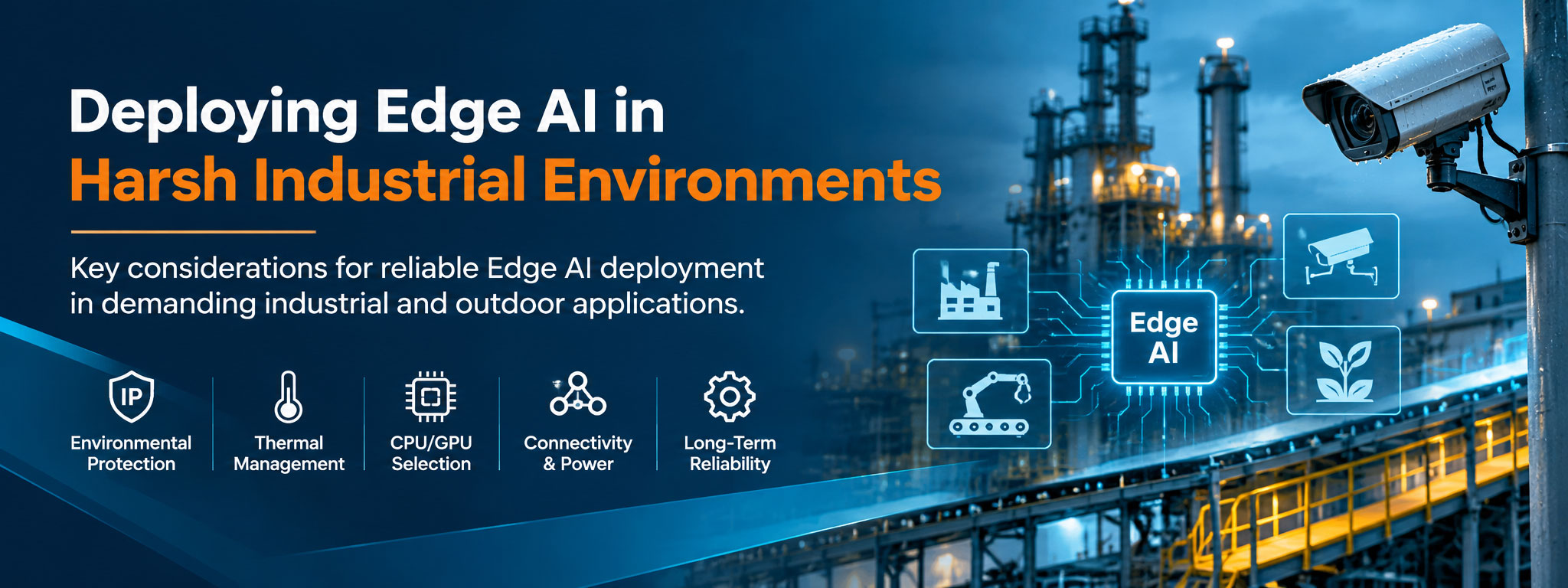
Deploying Edge AI in Harsh Industrial Environments
Key considerations for selecting reliable Edge AI computing systems in demanding industrial and outdoor applications.
Introduction
Edge AI is transforming how industrial organizations process data, monitor equipment, and make real-time decisions. By running AI workloads closer to cameras, sensors, and machinery, businesses can reduce dependence on cloud connectivity and enable faster local processing.
However, deploying Edge AI in harsh industrial environments requires more than selecting a processor with sufficient computing performance.
Dust, moisture, vibration, temperature extremes, network connectivity, and power stability can all affect system reliability. A successful deployment must balance AI performance with environmental protection, connectivity, thermal design, and long-term maintenance requirements.
This guide explores the key factors to consider when selecting an Edge AI computer for demanding industrial and outdoor applications.
1. Environmental Protection: Understanding IP Ratings
Industrial computers may be installed in factories, outdoor facilities, transportation infrastructure, or agricultural environments where exposure to dust and water is unavoidable.
Ingress Protection (IP) ratings help identify how effectively an enclosure protects against solid particles and water.
For example:
- IP65: Dust-tight protection against water jets.
- IP66: Dust-tight protection against powerful water jets.
- IP67: Dust-tight protection against temporary immersion under specified conditions.
A higher IP rating does not automatically mean a system is better suited to every application. The appropriate rating depends on the actual installation environment.
For outdoor or exposed industrial installations, engineers should also evaluate connector sealing, cable assemblies, enclosure mounting, and environmental exposure.
Deployment consideration: Verify that the complete installed system, including connectors and cables, meets the required environmental protection level.
2. Temperature and Thermal Management
Industrial Edge AI computers may operate in environments with substantial temperature variations.
Outdoor equipment can experience direct sunlight and seasonal temperature extremes, while factory installations may be exposed to heat generated by nearby machinery.
AI workloads also create thermal challenges because CPUs and GPUs can generate significant heat during sustained processing.
When evaluating a system, consider:
- Specified operating temperature range
- Temperature limitations associated with GPU configurations
- Fanless versus actively cooled designs
- Airflow requirements and mounting orientation
- Heat dissipation under continuous AI workloads
An operating temperature specification should always be reviewed together with its testing conditions and configuration limitations.
Deployment consideration: Validate thermal performance using the intended CPU, GPU, enclosure location, and sustained workload rather than relying only on nominal temperature specifications.
3. Choosing the Right CPU and GPU Configuration
AI computing requirements vary significantly depending on the application.
Basic equipment monitoring and sensor processing may require relatively modest computing resources, while multi-camera video analytics and advanced machine vision can demand greater acceleration.
The CPU typically manages operating system functions, device communication, and general processing tasks. A GPU or other AI accelerator can support computationally intensive inference workloads.
Key selection factors include:
- AI model requirements and inference latency
- Number and resolution of connected cameras
- Available CPU and GPU processing resources
- System memory and storage capacity
- Power consumption and thermal limitations
- Software compatibility and deployment requirements
Selecting the highest-performance GPU is not always the most effective approach. The objective is to match processing capability to the application's workload and operating conditions.
Deployment consideration: Benchmark the intended AI model on the actual hardware configuration before finalizing system selection.
4. Industrial Connectivity and Power Requirements
Reliable Edge AI deployment depends on the ability to connect cameras, sensors, controllers, and other industrial devices.
For vision-intensive applications, network bandwidth is particularly important.
Multi-camera systems may benefit from high-speed Ethernet connectivity, while Power over Ethernet (PoE) can simplify supported camera installations by combining network data and electrical power through compatible cabling.
Important connectivity considerations include:
- Gigabit, 2.5GbE, and 10GbE network requirements
- Camera interfaces and network bandwidth
- PoE power budgets and device compatibility
- Industrial connector types and cable protection
- Wireless connectivity requirements
- Network segmentation and cybersecurity
Power input characteristics are equally important.
Industrial and mobile installations may experience voltage fluctuations or interruptions. Wide-range DC input, appropriate power protection, and application-specific power management can help accommodate these conditions.
Deployment consideration: Calculate the complete system power budget, including the computer, GPU, storage, connected devices, and optional PoE loads.
5. Mechanical Design and Long-Term Reliability
Even when computing performance and environmental specifications meet project requirements, mechanical integration can influence deployment success.
Industrial installations may be subject to continuous vibration, mechanical shock, restricted mounting space, and difficult maintenance access.
Engineers should evaluate:
- Enclosure dimensions and mounting options
- Vibration and shock requirements
- Connector retention and cable routing
- Accessibility for servicing and replacement
- Storage and expansion configurations
- Software support and system lifecycle requirements
For remote installations, maintenance accessibility can be especially important because servicing equipment may require additional labor, travel, or operational downtime.
Deployment consideration: Review installation, service access, and replacement procedures during system design rather than after deployment.
6. Matching Edge AI Hardware to Real-World Applications
Different industrial applications place different demands on Edge AI hardware.
Outdoor Video Surveillance
Requires environmental protection, reliable camera connectivity, and sufficient processing resources for video analytics.
Industrial Automation
Emphasizes machine vision integration, stable operation, industrial networking, and compatibility with existing automation infrastructure.
Smart Agriculture
May require protection against dust, moisture, and temperature variations, together with connectivity for distributed cameras and sensors.
Intelligent Transportation
Can involve vibration, variable power conditions, and integration with transportation infrastructure or mobile equipment.
Remote Industrial Monitoring
Prioritizes reliable unattended operation, network availability, power management, and simplified maintenance.
The most suitable system depends on the specific installation conditions, AI workload, and integration requirements.
7. A Practical Edge AI Deployment Checklist
Before selecting an industrial Edge AI computer, confirm the following:
- Environment: What levels of dust, water exposure, vibration, and temperature must the system withstand?
- Performance: What CPU, GPU, memory, and storage resources does the AI workload require?
- Connectivity: How many cameras, sensors, and network devices must be connected?
- Power: What input voltage, power budget, and protection features are required?
- Integration: Does the hardware support the intended operating system, software stack, and industrial interfaces?
- Maintenance: How will the system be monitored, serviced, and supported throughout its operational life?
Addressing these questions early can help reduce integration risks and improve deployment planning.
Conclusion
Deploying Edge AI in harsh industrial environments requires a system-level approach.
AI processing capability is important, but long-term deployment success also depends on environmental protection, thermal management, industrial connectivity, power stability, and mechanical integration.
By evaluating these factors together, organizations can select Edge AI computing platforms that better match real-world operating conditions and application requirements.
SINTRON provides rugged industrial and Edge AI computing solutions for demanding environments, including the ABOX-5221(P)(G)-IP66, which combines IP66 protection, configurable GPU acceleration, and high-bandwidth networking for industrial and outdoor deployments.
Explore SINTRON Edge AI Computing Solutions or contact our team to discuss your project requirements.
